By Madhuri Rajkumar
Keeping up with the demands of academic/work life can be overwhelming! As emerging occupational psychologists, however, we are laying in a goldmine of theories and frameworks to overcome the challenges of occupational life.
So, why not use it for ourselves?
In this blog, let’s discuss a skill that can make your life easier and less overwhelming, if approached (that’s a clue) the right way: Goal-setting.

As a Master’s student, I’ve explored many tools that promise a shorter, clearer, and easier path to success. ‘Put your desires into grids and boxes and you’re halfway there!’ Influenced by these popular goal-setting strategies and techniques, I’ve come up with S.M.A.R.T goals (and not-so-smart ones). While some looked great on paper, few turned messy in action. Some goals made me feel like I was already on top of the highest mountain; while others made me rethink life choices at the foothill.
Ultimately, it wasn’t the methodology that helped me (although necessary); no matter how specific, measurable or timed the goals were, it was the ‘Why am I doing this?’ that made me perform.
Let’s start there!
When you hit a snag in goal achievement or don’t know how to follow through on a goal, ask yourself a simple question:
‘What were you expecting?’
Not to be condescending or sarcastic! – but to understand what drove you to set the goal in the first place. The answer to this question presents two underlying constructs in goal-setting: avoidance and achievement.
If you haven’t heard of these terms yet, you will soon come across them in the 2×2 matrix of Andrew J. Elliot; it involves a theory that outlines the internal factors of motivation. Let me explain to those who stuck around even after I said ‘theory’.
The Achievement Goal Theory: Approach (that’s another clue) Matters!
We self-evaluate our performance and come to a conclusion, or in other words, define our competence, using three standards, which I’ve reframed as questions:
- Am I succeeding in doing this task?
- Am I learning something new or accomplishing something I didn’t before?
- Am I performing better than or like others?
Competence is also measured in terms of valence—success/positive outcomes and/or failure/negative outcomes. A ‘valence-based’ evaluation of goals brings out our avoidance or approach tendencies. We either find ourselves approaching goals expecting a positive outcome like growth and achievement (mastery), e.g., goals such as attending a seminar, learning a new skill. Or, we might find ourselves avoiding something we think might turn out negatively, like working on a dissertation, applying for a job, or attending an interview. There is a risk margin for such goals. We might feel the urge to avoid the criticism, negative evaluation or judgement that accompanies a possible failure or setback.

The underlying emotions behind the approach-avoidance perspective is the real predictor of motivation. Think of a goal you are trying to avoid out of a fear of a negative outcome. Now try to reframe that negative outcome to something positive. Let’s do it together:
Step 01: Write down your goals on a paper. Be sure to record all your goals without disregarding any because you think they might be unattainable. We will evaluate their feasibility at a later time.
Step 02: Categorise them into four boxes as given in the image, e.g., Goals that come under Mastery – Approach, Mastery – Avoidance, etc. This will help you uncover the emotional-basis of your goal approach. Refer to this grid to understand the meaning of each box heading so you can place your goal in the appropriate box.
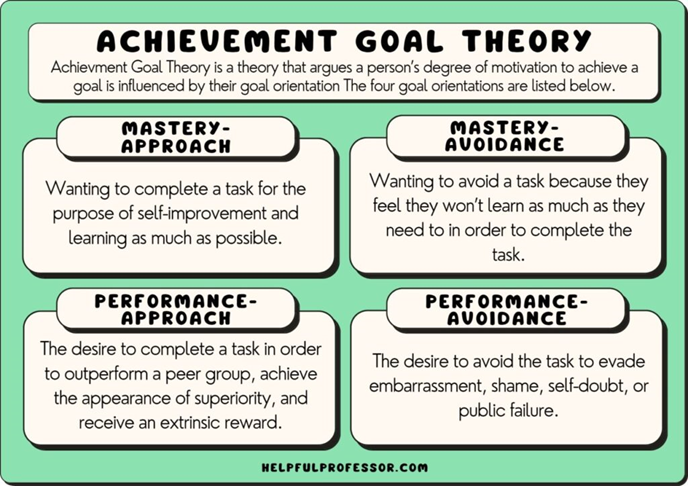
Step 03: Reassess and recategorise your goals. Even if there are overwhelming, seemingly impossible-to-attain goals, reconsider why you may be putting them in the ‘avoid’ category. What is the underlying fear or self-judgement stopping you? You can write them down, discuss them with a coach or mentor or simply self-reflect. This might bring out a different perspective or motivation, or even the courage to approach something difficult.
Now, is there any goal that you would like to relocate from avoidance to approach?
Here’s my example:
Recently, I was trying to use Microsoft Excel to organise my literature review references. An overwhelming fear of not being able to do it right took over and I gave up on my task halfway. The next day, however, when I opened Excel with the determination to learn something new even if I won’t be able to master it, I ended up learning the application and organising my references with ease—ironically, mastering Excel. This is how I moved an overwhelming task from ‘avoidance’ to ‘approach’.
As an emerging graduate, it’s a good idea to spend a window of time planning your goal-setting approach. The Achievement Theory matrix gives clarity on your goal motivations and progress—and can help you tackle the stress and overwhelm of meeting all your goals. We’ll talk more about goal-setting in subsequent blogs; for now, I would like you to reflect on your goals and your approach towards them. We would love to hear about your progress!
As an emerging graduate, it’s a good idea to spend a window of time planning your goal-setting approach. We’ll talk more about goal-setting in subsequent blogs; for now, I would like you to reflect on your goals and your approach towards them. We would love to hear about your progress! If interested, you may read more about the Achievement Goal Theory here.

 Psychology at Work