Categories
Uncategorized

HOW TO MAKE THE BEST OUT OF YOUR MENTORING SESSIONS

NOTES FROM AN EX-MENTEE (ALSO A LIFELONG LEARNER)

“Mentorship is the bridge that turns potential into performance.”

As we near the end of an intensive degree and many of us are already in job-search mode, it’s crucial to seek and embrace all the support we can get. Being a lifelong early bird, I joined Psychology At Work’s 2023/24 ‘Emerging Occ Psychs’ mentoring cohort, hoping to gain the clarity and direction I needed to map out my career.

Now, as my partnership with my mentor concludes, I realise that this was a strategic and pivotal move that I made—one that provided me a clear path forward to define my career goals and next steps.

A mentor is an experienced and trusted advisor who provides guidance and support, often to a less experienced individual, commonly known as a mentee. This relationship isn’t a one-way lecture; rather, it’s a dynamic, two-way exchange of ideas, feedback, and learning. This interaction ultimately helps identify strengths, areas for improvement, and sets the foundation for creating and achieving goals. There are various mentoring models, such as the GROW model or the FUEL model, but the expectations and initial discussions between mentor and mentee usually set the tone for how the sessions are conducted. Each mentor-mentee relationship is unique, has a different process and can lead to different outcomes. I’d like to briefly share my own experience being a mentee:

As a member of the 2023/24 cohort, I was paired with an experienced Learning and Development (L&D) professional, which aligned with my career goals. However, at the time, I was open to speaking with just about anyone in any field, as my main goal was simply to get started. Our first session focussed on understanding each other’s expectations and past experiences. This was the most crucial stage in the process because it helped me develop a sense of trust and confidence in my mentor. I felt at ease and could openly, without fear of judgement, share my concerns and fears related to my career and professional development. Over the next eight sessions, we discussed my strengths as well as potential areas where I could stand out, based on my skills and interests. We then delved into the different avenues I could explore to shape my career strategy. Since L&D is a broad field and my skills ranged from customer service to research and consultancy, my mentor encouraged me to consider areas that slightly diverged from my profile but would still be a good fit, such as internal communications and sales. Through these sessions, I gained the clarity I needed. I knew where I stood, and what I needed to do next to move forward. As important as this strategic process was, what I valued most was the emotional support I received throughout the sessions. My mentor consistently provided me with mini-tasks to challenge my self-defeating assumptions and help me break through mental barriers. This approach not only made me more accountable for my career goals but also encouraged me to prioritise my mental health throughout the journey.

In sharing my experience, I want to highlight why these sessions had such a significant impact on me and ultimately proved to be a success. While the mentor, who is a subject matter expert or industry professional, is highly trained and skilled at guiding and coaching their mentee, the success of the collaboration also depends on the mentee’s preparedness to fully leverage these sessions. Here’s four steps for how I ensured that all eight sessions brought me closer to achieving my career goals.

Step 1: Know Your Mentor

As soon as I was informed of who my mentor would be, I immediately visited their LinkedIn profile to learn more about the person I would be engaging with. This is also a crucial tip for job searching: it’s important to fully understand the breadth and depth of experience and knowledge of the person you’ll be speaking with. By doing this, you can ask targeted questions during your initial discussion, based on what you’ve learned from their profile. This approach not only aids in building rapport but also opens up avenues for interesting conversations about your mentor’s own journey—elements of which might inspire your own.

Here are some questions you can ask; remember, the more in-depth your questions, the more you’ll gain from the conversation. This approach might even open up potential work opportunities for you.

  • “I noticed from your LinkedIn profile that you used to work in ____. That really caught my interest, as I never knew a role like that existed. Could you tell me more about it and how you got into it?”
  • “It’s truly inspiring how you advanced from position X to position Y within your company. What approaches worked and did not work out for you during your journey?”
  • “In your ‘About Me’ section on LinkedIn, I saw that you are part of a community for ____. I’m really interested in hearing about this group and whether they’re on the lookout for a volunteer/intern?”

Step 2: Be Open and Honest

While you’re not obliged to share anything you’re not comfortable with, it’s important to remember that this is a safe and collaborative space. Your mentor is there to help you, and to do that effectively, you need to be transparent. Share your current situation, challenges, aspirations, and any obstacles you’re facing. If you find yourself at a loss for words or struggling to articulate your thoughts, consider asking your mentor the following questions to guide the conversation and signal that you need a bit of assistance.

  • “There are some thoughts in my head and I’m not sure how best to phrase them.”
  • “If you could ask me some questions that would help me share my career ideas, that would make this much easier.”

Step 3: Do Your Homework

We have a lot on plates, agreed! There’s the constant juggling of personal lives with job-hunting. We have to think about our relationships, our commitments, our health and well-being as much as we do have to be on our laptops, scouring the internet for opportunities. It might be a good idea, therefore, to use the mentoring sessions as a sort of planner to prioritise your time. If your mentor gives you homework, in the form of small tasks and goals to achieve, those probably would help optimise your time, and that’s why it’s always important to follow through on them (e.g., my mentor asked me to reach out to 5 LinkedIn associations in the L&D space each week with a tailored message). I prioritised this task over all the other million aimless things I’d be doing, and as expected, was able to have insightful conversations with industry experts that helped me tap into new opportunities in the field—avenues I wouldn’t have explored before. To set yourself up for success, I also recommend coming up with some ideas of your own.

  • “What can I focus on for this month based on my current career goals?”
  • “How do you recommend breaking down this task into manageable steps?”
  • “What are some best practices for writing personalised messages to potential industry contacts?”

Step 4: Own Your Sessions

Your mentor is there to guide and support you, but the journey of job-hunting is yours alone, and its accountability is yours to shoulder. It’s easy to become passive and dependent on someone more experienced to pave your way forward—it’s social psychology! However, the most productive and ultimately successful mentor-mentee relationships are those where the mentee takes the reins and actively collaborates to achieve goals and maintain progress. Try these out and own your sessions: Schedule your sessions by being the one to reach out first (unless session dates are pre-set). Reach out to update your mentor and share your progress and difficulties so that they are prepared to discuss them in the next session. Adjust your sessions and goals to best fit your needs; after all, this is for you.

  • “Would you prefer I reach out a few days before our sessions to confirm the agenda?”
  • “Since our last session, I’ve made some progress on _________. Here’s some challenges I’m facing, though. Could we discuss this in our next meeting?”
  • “I’d appreciate your feedback on how you think I’m progressing, and any improvements you would suggest?”

Finally, and I’m sure we’re all good at this, but be sure to show your appreciation and gratitude for your mentor’s time and investment in your professional development.

Occasionally, to express your gratitiude, write them a thank you message:

“Thank you so much for your time and efforts. Your advice and encouragement have made a significant difference in my approach to job-hunting.”

“I appreciate all your help and advice on ___________. It’s been very useful.”

Signing up for mentoring is a wise step that shows your dedication to improving yourself, focussing on your goals, and striving to achieve them. The Emerging Occ Psychs initiative can further support this journey by offering events and mentoring to recent graduates of MSc programmes in occupational psychology and related disciplines. It opens applications for mentees each October and operates on a first come first served basis. You can learn more about the initiative HERE, and follow the PAW LinkedIn account HERE.

All the best on your career journey! Onwards & upwards 😀

Categories
Uncategorized

Success Begins with Your Pre-Goal Mindset

By Madhuri Rajkumar

So, why not use it for ourselves?

In this blog, let’s discuss a skill that can make your life easier and less overwhelming, if approached (that’s a clue) the right way: Goal-setting.

Ultimately, it wasn’t the methodology that helped me (although necessary); no matter how specific, measurable or timed the goals were, it was the ‘Why am I doing this?’ that made me perform.

Let’s start there!

When you hit a snag in goal achievement or don’t know how to follow through on a goal, ask yourself a simple question:

‘What were you expecting?’

Not to be condescending or sarcastic! – but to understand what drove you to set the goal in the first place. The answer to this question presents two underlying constructs in goal-setting: avoidance and achievement.

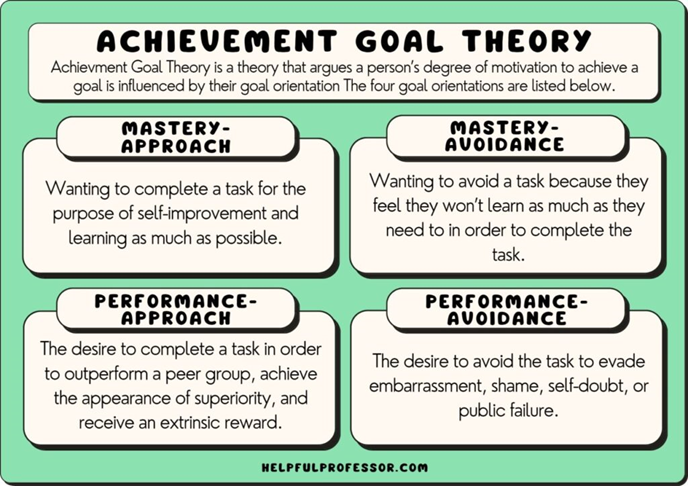
If you haven’t heard of these terms yet, you will soon come across them in the 2×2 matrix of Andrew J. Elliot; it involves a theory that outlines the internal factors of motivation. Let me explain to those who stuck around even after I said ‘theory’.

The Achievement Goal Theory: Approach (that’s another clue) Matters!

We self-evaluate our performance and come to a conclusion, or in other words, define our competence, using three standards, which I’ve reframed as questions:

  • Am I succeeding in doing this task?
  • Am I learning something new or accomplishing something I didn’t before?
  • Am I performing better than or like others?

Competence is also measured in terms of valence—success/positive outcomes and/or failure/negative outcomes. A ‘valence-based’ evaluation of goals brings out our avoidance or approach tendencies. We either find ourselves approaching goals expecting a positive outcome like growth and achievement (mastery), e.g., goals such as attending a seminar, learning a new skill. Or, we might find ourselves avoiding something we think might turn out negatively, like working on a dissertation, applying for a job, or attending an interview. There is a risk margin for such goals. We might feel the urge to avoid the criticism, negative evaluation or judgement that accompanies a possible failure or setback.

Source: Verdin, Dina & Godwin, Allison & Morazes, Jennifer. (2015). Qualitative study of first-generation latinas: Understanding motivation for choosing and persisting in engineering. ASEE Annual Conference and Exposition, Conference Proceedings. 122.

The underlying emotions behind the approach-avoidance perspective is the real predictor of motivation. Think of a goal you are trying to avoid out of a fear of a negative outcome. Now try to reframe that negative outcome to something positive. Let’s do it together:

Step 01: Write down your goals on a paper. Be sure to record all your goals without disregarding any because you think they might be unattainable. We will evaluate their feasibility at a later time.

Step 02: Categorise them into four boxes as given in the image, e.g., Goals that come under Mastery – Approach, Mastery – Avoidance, etc. This will help you uncover the emotional-basis of your goal approach. Refer to this grid to understand the meaning of each box heading so you can place your goal in the appropriate box.

Step 03: Reassess and recategorise your goals. Even if there are overwhelming, seemingly impossible-to-attain goals, reconsider why you may be putting them in the ‘avoid’ category. What is the underlying fear or self-judgement stopping you? You can write them down, discuss them with a coach or mentor or simply self-reflect. This might bring out a different perspective or motivation, or even the courage to approach something difficult.

Now, is there any goal that you would like to relocate from avoidance to approach?

Here’s my example:
Recently, I was trying to use Microsoft Excel to organise my literature review references. An overwhelming fear of not being able to do it right took over and I gave up on my task halfway. The next day, however, when I opened Excel with the determination to learn something new even if I won’t be able to master it, I ended up learning the application and organising my references with ease—ironically, mastering Excel. This is how I moved an overwhelming task from ‘avoidance’ to ‘approach’.

As an emerging graduate, it’s a good idea to spend a window of time planning your goal-setting approach. The Achievement Theory matrix gives clarity on your goal motivations and progress—and can help you tackle the stress and overwhelm of meeting all your goals. We’ll talk more about goal-setting in subsequent blogs; for now, I would like you to reflect on your goals and your approach towards them. We would love to hear about your progress!

As an emerging graduate, it’s a good idea to spend a window of time planning your goal-setting approach. We’ll talk more about goal-setting in subsequent blogs; for now, I would like you to reflect on your goals and your approach towards them. We would love to hear about your progress! If interested, you may read more about the Achievement Goal Theory here.

Categories
Uncategorized

On Scientific Curiosity: Why we need to ask more ‘Whys’

By Madhuri Rajkumar

In the 20th century, in a bustling suburb of metropolitan Chicago, a telephone equipment company – the Western Electric Company – emerged as a monopoly supplier of telecommunication hardware. There was an interesting phenomena being studied at Hawthorne, where their factory was located—the subsequent investigations puzzled the factory owners, academicians, and industry experts.

Now, before I proceed with this story, let me ask you a question.

What, in your opinion, drives your productivity?

Here are some common answers:

  • The anticipation of receiving a reward, like a bonus or incentive
  • A determination to succeed at something challenging, new or interesting
  • A sense of commitment to what you have chosen to do
  • The pleasant feeling that arises when being noticed or validated for your work

At Hawthorne, a study was conducted to understand the effects of changing work conditions, like lightning, break times, etc., on the productivity/performance of employees. Somehow, the employees consistently produced high output even when the experimental conditions included longer working hours and shorter breaks. Who would ever feel motivated to perform under these conditions? Would you?

This led to the first and most important question a researcher/scientist/psychologist should ask: ‘Why?’

Children ask ‘Why?’ expecting an epic story to something as mundane as the working of cars or the flowering of a tree. ‘But why?’ they ask, a million times, to the frustration of parents who become the best storytellers in that moment of interrogation. But this small yet powerful word becomes the gateway to valuable information about others/the world and oneself. 

Somewhere along the way, however, we outgrew this stage and started accepting close-ended answers to our questions, in the form of rules and facts, often categorised as wrong or right. Conforming to the rules and keeping within bounds meant security and sustenance.

As a psychologist, however, we decide to be anti-conformists. The grey area of not knowing keeps us motivated to test new hypotheses and develop new theories. We regress into the child-like habit of asking ‘Why?’ And the subsequent investigation on why people do things or behave the way they do leads to new insights that make life easier – like what happened in the Hawthorne Studies.

So, what was happening at Hawthorne?

The factory owners at Hawthorne became interested in this productivity phenomena and they wanted to use whatever was happening there to improve productivity of all their employees. So, they called in the big guns — academicians like Elton Mayo, who insisted on understanding the behavioural and psychological reasons behind productivity. His deep dive into this aspect of motivation developed some turning-point answers in management studies. It became evident that people want to be noticed, attended to and cared for. They want to be involved and regarded, rewarded and understood. If this discovery didn’t happen, we would have been ages behind in understanding employee motivation and consequently developing effective management techniques. So, cheers to Elton, the other investigators and the factory owners who didn’t stop asking ‘Why?’

“When curiosity turns to serious matters,
it’s called research.” 
Marie von Ebner-Eschenbach

Every day we make observations. We make observations about the people around us, our surroundings, and if self-reflective enough, about ourselves. Out of these, even if we choose to ignore some, something else might keep us awake, wondering ‘Why?’ And there begins your scientific journey to establish lines of evidence to either credit or discredit these observations. Once you’ve arrived at satisfactory conclusions, you apply them to real life and test the outcomes. It doesn’t stop there. You test and re-test, keeping in mind that there is no right or wrong, only a series of developments to how things were vs how things can be.

So, fellow psychologists, here are some takeaway messages, not only from enterprising studies like the Hawthorne Experiments, but as observed from instances of daily life:

  • Be constantly and forever intellectually curious
  • Do not limit yourself to a single answer; yearn to know more
  • Finding evidence to prove yourself wrong is also as valuable as evidence to prove yourself right (A good observation/study is always falsifiable)
  • Use your curiosity for the good of others, with a determination to make their lives better or easier

Elton Mayo and his fellow researchers played a role in inspiring a culture of active listening, empathy and interpersonal support in the Western Electric Company, positively influencing many workers’ lives – all because they couldn’t stop thinking about why people kept working under poor lighting.

Here’s a link to read more about the Hawthorne Experiments, the ‘Hawthorne Effect’, and its various implications: https://www.bl.uk/people/elton-mayo. We’ll also talk about Evidence-based Practice (in later blogs), which is the standard in Occupational Psychology (briefly mentioned through the diagram above). And once inspired,

Take a look at the world around you, your work or academic space and think of where you may have missed out on asking the big question: ‘Why?’

Categories
Blog Piece

Finding Your Role

By Nikita Mikhailov

It can be tough submitting application after application and getting rejections and or not hearing anything at all, I have been there. Though here are some tips that might make it easier for you:

“I am passionate about psychology”

Is that your opening line? Well I have some news – about 95% of cover letters start with that. Here are some alternatives: “I am psychological about passion” (thank you Wendy Lord for that one) “I find ……. particularly interesting in Psychology”.

Sending an application without a message or a call first

I know that you have hundreds of applications to send, but take your time to have a call or even pop down for a coffee to the office to have a chat about the role. To find out more about the role and the company and to see if it really is for you.

The job title might not have the word psychologist in it: Maybe looking at job sites for “psychologist” is not the only way to go. Identify what you are particularly interested in about psychology and search for that, it can be “Psychometrics”, “personality assessment”, “culture change”, etc… and you might be surprised of what job title of a role that is a perfect for you Ok, what about going passed job boards all together.

LinkedIn and networking

Not only is LinkedIn a great source for job ads but it’s also a brilliant place to network, even with people you have not yet met. So after you have identified what you really find interesting, however specific it may be (e.g. “Personality assessments” “psychological well-being of firefighters”) go and search LinkedIn for people who do exactly that. After you find them message them with an invite saying how you find there are of work to be fascinating and you love to talk more about it. You already have a shared interest in common and maybe there is an internship opportunity, shadowing etc. When you have a chat ask them “is there anyone else they think that you should meet?” This might give you the opportunity to meet some fellow colleagues.

Have fun. Go to events, meet people one to one (public places and all that). Skype people who you think are ace in the what they do. The world is full of very interesting Psychologists doing some great stuff that they would be happy to talk about.

Psychology is a fascinating field where getting paid allows you to do what you love! Wishing you the very best in your career dear colleague! Anything you would like to add as far as finding the job in Occ/Business Psych? Drop us an message!

Job boards

There are many good job boards: indeed, totaljobs, monster and many more, search them as well. Here are psychology specific ones that we know of in the UK:

BPS British Psychological Society runs this great website, where you can find jobs not only in Occ Psych but also in other branches of psychology https://www.jobsinpsychology.co.uk/

Association for Business Psychology You can look for jobs: https://theabp.org.uk/job-dashboard/jobs/ And volunteering opportunities: https://theabp.org.uk/job-dashboard/volunteering-opportunities/

Other resources that might be useful: Uzma Waseem from ABP has written this brilliant article on how to look for a job during lockdown https://theabp.org.uk/steering-through-the-job-market-during-lockdown/

About the Author

Nikita Mikhailov is a Psychometrician, his mission is to share the goodness of psychology. He is Business Psychologist, and a member of the British Psychological Society. His clients include Fortune 500 companies, start ups, individuals and couples. He specialises in supporting companies in recruitment and development of talent through a combination of psychometrics and coaching. His particular interest lies in how personality assessments can be used to increase self awareness and to help people make practical steps towards being more effective leaders and living more meaningful and fulfilling lives.

Categories
Occupational Psychology

Lessons from the PCL Student Sponsorship Programme

Recent weeks have been hectic for MSc Course Directors. Tasked not only with assessing final dissertations submitted by students from the previous year, they have also been putting plans in place to welcome and induct new students into their MSc programmes for the 2019/20 academic year.

From the student perspective, a fresh cohort of MSc graduates has been released on the job market, keen to begin recuperating the investment of their education. Yet for some, the feeling of elation experienced by graduating may soon be replaced with a sense of disappointment as the exciting range of employment opportunities they expected fails to materialise. This is a situation I am all too familiar with; the gap between graduation to early career placement can feel like a chasm.

After starting work for Psychological Consultancy Ltd (PCL) over 4 years ago, we began considering ways in which I could help graduates minimise some of the difficulties I faced when breaking into the industry. These methods benefited from hindsight, and not only included things I had done, but things I had not. Any actions not only needed to help future graduates, but also to provide a return on investment for PCL.

As an assessment publisher, we have an ongoing responsibility to demonstrate the validity of our tools. Research cuts to the core of this. The insight we generate serves to inform product development and improve the education and training of our test users. Reflecting on ways of generating this insight led me to consider the work students engage in during their courses. The dissertations of MSc students not only form a key component of programmes; they represent a potential conduit for obtaining essential validation data.

This led me to conclude that our goal was to create and develop a process that facilitated a win-win outcome for both students and PCL, and the MSc dissertation represented the best vehicle for this.

The Role of the Dissertation

Photo by Patrick Tomasso on Unsplash

A dissertation is likely to be a student’s greatest academic achievement for a single piece of work. The culmination of months of effort, it encompasses a range of skills including (but not limited to) review of the evidence base, writing proficiency, research methodology and project management. It also provides insight into a student’s interests and the directions they may want to take in navigating the profession. In short, it represents a foundation stone of the personal brand students will cultivate over the course of their professional career.

To some, a dissertation is viewed solely as a constituent part of their overarching MSc. The goal of completing it is to receive a score that combines with those of other modules to create an overall grade. Whilst this is true, an MSc dissertation can represent so much more than that. The goal of our involvement with students was to help them consider untapped opportunities generated by their MSc dissertations in a manner that justified PCL’s support. The result of our efforts to achieve this led to the creation of the PCL ‘Student Sponsorship Programme’ (SSP).

PCL’s Student Sponsorship Programme

The SSP is a competitive process involving approximately 20 UK-based universities running MSc courses in occupational psychology and related fields. Students interested in taking part are invited to submit a short 500-word application by the 11th November. The lynchpin of the SSP is the MSc dissertation, so students’ applications must demonstrate consideration for how PCL products could play a role in their research.

Applicants are informed of the status of their application several days after the deadline, and unsuccessful applicants are offered the chance to have a Skype or phone call with a consultant to discuss their research projects.

Our support starts in mid-December when we welcome successful applicants to our offices in Tunbridge Wells. This ‘Professional Skills Event’ is crammed with content that includes introductions to our assessments and sessions on consultancy, research skills and marketing.

The following months involve ongoing remote contact where we help the students pinpoint and flesh out their research ideas into actionable projects. Once these are identified, the next step is data collection. A significant obstacle for all students, PCL can provide support through our professional contacts and social media presence. Our help extends through to the analysis and write-up stages, with PCL staff on hand to respond to any questions the students may have.

Students have frequently noted the benefits of the programme. PCL staff represent an accessible source of expertise that can respond to students’ questions and concerns, thereby supplementing the support provided by academics. Working with a test publisher also provides the added benefit of enabling students to remotely and automatically deliver bespoke feedback reports to their participants.

Working with a consultancy can also provide opportunities for professional development. This relationship helps the student develop a practitioner mindset that encourages them to think about how academic research can be applied to the client-focussed services offered by consultancies. PCL represents another stakeholder in their project, and the student must reciprocate the support they receive by providing us with the insight resulting from their research.

Submission deadline day for dissertations typically represents the culmination of a student’s MSc journey. However, this is not the case for our SSP students!

Beyond Submission

After a well-earned break from their efforts, communications with the new graduates resume with discussions about next steps. The former students will have developed a range of skills and knowledge during their MSc, so the next goal is to make these as visible as possible. Networking and engagement forms part of this visibility, with the former students encouraged to continue applying the lessons introduced during the professional skills event.

This leads to the most significant next step in the context of the SSP: content dissemination. Students are strongly encouraged to make the most of their research beyond the dissertation. Luckily, disseminating content from dissertations is easier than ever! There are various platforms capable of hosting and distributing content that can be seen by peers, the wider public and potential employers. The SSP graduates can also benefit from uploading to PCL’s online ‘Knowledge Bank’, which hosts a range of freely accessible content.

Outputs emerging from the SSP include white papers, industry publications, blog pieces, video content and conference presentations. Translating an MSc dissertation into each of these formats requires the student to develop a more diverse skillset and cements the benefits of ongoing learning that all psychologists should engage in throughout their careers.

Lessons from the SSP

Photo by Helloquence on Unsplash

We have learned a great deal as facilitators of the SSP but feel many of these lessons are equally applicable to students, recent graduates, and academics. Recommendations include:

  • Do not view your dissertation as a single piece of work. Instead, look to break it up and disseminate it across various platforms using different formats.
  • Consider approaching your research as a consultancy project in and of itself. Engage with organisations and offer feedback on what you find, even if it’s for free!
  • Create and foster habits that improve your personal brand. Engage with posts and thought leaders relevant to your interests during and after your research.
  • Aim to use your research as a vehicle for engaging with the industry and community. You’ve developed MSc-level knowledge on a specific topic, so use it!

The list of achievements by SSP alumni is extensive and growing year on year. For students, we believe the SSP provides unique insight into the industry that enriches their knowledge and increases their employability. For consultancies, we believe the SSP represents a replicable framework that bridges the academic-practitioner divide and generates win-win outcomes for all involved.

Call for Applicants

Are you or someone you know completing an MSc in Occupational Psychology (or related field) during the 2019/20 academic year?

You can find more information about the SSP on the PCL website, including the SSP brochure, previous outputs, contact details and testimonials.

The deadline for applications to the next intake of the SSP is Monday 11th November 2019.

About the Author

Dr Simon Toms is a Principal Research Psychologist with Psychological Consultancy Ltd, and a Chartered Psychologist and Associate Fellow of the British Psychological Society.