Categories
Uncategorized

HOW TO MAKE THE BEST OUT OF YOUR MENTORING SESSIONS

NOTES FROM AN EX-MENTEE (ALSO A LIFELONG LEARNER)

“Mentorship is the bridge that turns potential into performance.”

As we near the end of an intensive degree and many of us are already in job-search mode, it’s crucial to seek and embrace all the support we can get. Being a lifelong early bird, I joined Psychology At Work’s 2023/24 ‘Emerging Occ Psychs’ mentoring cohort, hoping to gain the clarity and direction I needed to map out my career.

Now, as my partnership with my mentor concludes, I realise that this was a strategic and pivotal move that I made—one that provided me a clear path forward to define my career goals and next steps.

A mentor is an experienced and trusted advisor who provides guidance and support, often to a less experienced individual, commonly known as a mentee. This relationship isn’t a one-way lecture; rather, it’s a dynamic, two-way exchange of ideas, feedback, and learning. This interaction ultimately helps identify strengths, areas for improvement, and sets the foundation for creating and achieving goals. There are various mentoring models, such as the GROW model or the FUEL model, but the expectations and initial discussions between mentor and mentee usually set the tone for how the sessions are conducted. Each mentor-mentee relationship is unique, has a different process and can lead to different outcomes. I’d like to briefly share my own experience being a mentee:

As a member of the 2023/24 cohort, I was paired with an experienced Learning and Development (L&D) professional, which aligned with my career goals. However, at the time, I was open to speaking with just about anyone in any field, as my main goal was simply to get started. Our first session focussed on understanding each other’s expectations and past experiences. This was the most crucial stage in the process because it helped me develop a sense of trust and confidence in my mentor. I felt at ease and could openly, without fear of judgement, share my concerns and fears related to my career and professional development. Over the next eight sessions, we discussed my strengths as well as potential areas where I could stand out, based on my skills and interests. We then delved into the different avenues I could explore to shape my career strategy. Since L&D is a broad field and my skills ranged from customer service to research and consultancy, my mentor encouraged me to consider areas that slightly diverged from my profile but would still be a good fit, such as internal communications and sales. Through these sessions, I gained the clarity I needed. I knew where I stood, and what I needed to do next to move forward. As important as this strategic process was, what I valued most was the emotional support I received throughout the sessions. My mentor consistently provided me with mini-tasks to challenge my self-defeating assumptions and help me break through mental barriers. This approach not only made me more accountable for my career goals but also encouraged me to prioritise my mental health throughout the journey.

In sharing my experience, I want to highlight why these sessions had such a significant impact on me and ultimately proved to be a success. While the mentor, who is a subject matter expert or industry professional, is highly trained and skilled at guiding and coaching their mentee, the success of the collaboration also depends on the mentee’s preparedness to fully leverage these sessions. Here’s four steps for how I ensured that all eight sessions brought me closer to achieving my career goals.

Step 1: Know Your Mentor

As soon as I was informed of who my mentor would be, I immediately visited their LinkedIn profile to learn more about the person I would be engaging with. This is also a crucial tip for job searching: it’s important to fully understand the breadth and depth of experience and knowledge of the person you’ll be speaking with. By doing this, you can ask targeted questions during your initial discussion, based on what you’ve learned from their profile. This approach not only aids in building rapport but also opens up avenues for interesting conversations about your mentor’s own journey—elements of which might inspire your own.

Here are some questions you can ask; remember, the more in-depth your questions, the more you’ll gain from the conversation. This approach might even open up potential work opportunities for you.

  • “I noticed from your LinkedIn profile that you used to work in ____. That really caught my interest, as I never knew a role like that existed. Could you tell me more about it and how you got into it?”
  • “It’s truly inspiring how you advanced from position X to position Y within your company. What approaches worked and did not work out for you during your journey?”
  • “In your ‘About Me’ section on LinkedIn, I saw that you are part of a community for ____. I’m really interested in hearing about this group and whether they’re on the lookout for a volunteer/intern?”

Step 2: Be Open and Honest

While you’re not obliged to share anything you’re not comfortable with, it’s important to remember that this is a safe and collaborative space. Your mentor is there to help you, and to do that effectively, you need to be transparent. Share your current situation, challenges, aspirations, and any obstacles you’re facing. If you find yourself at a loss for words or struggling to articulate your thoughts, consider asking your mentor the following questions to guide the conversation and signal that you need a bit of assistance.

  • “There are some thoughts in my head and I’m not sure how best to phrase them.”
  • “If you could ask me some questions that would help me share my career ideas, that would make this much easier.”

Step 3: Do Your Homework

We have a lot on plates, agreed! There’s the constant juggling of personal lives with job-hunting. We have to think about our relationships, our commitments, our health and well-being as much as we do have to be on our laptops, scouring the internet for opportunities. It might be a good idea, therefore, to use the mentoring sessions as a sort of planner to prioritise your time. If your mentor gives you homework, in the form of small tasks and goals to achieve, those probably would help optimise your time, and that’s why it’s always important to follow through on them (e.g., my mentor asked me to reach out to 5 LinkedIn associations in the L&D space each week with a tailored message). I prioritised this task over all the other million aimless things I’d be doing, and as expected, was able to have insightful conversations with industry experts that helped me tap into new opportunities in the field—avenues I wouldn’t have explored before. To set yourself up for success, I also recommend coming up with some ideas of your own.

  • “What can I focus on for this month based on my current career goals?”
  • “How do you recommend breaking down this task into manageable steps?”
  • “What are some best practices for writing personalised messages to potential industry contacts?”

Step 4: Own Your Sessions

Your mentor is there to guide and support you, but the journey of job-hunting is yours alone, and its accountability is yours to shoulder. It’s easy to become passive and dependent on someone more experienced to pave your way forward—it’s social psychology! However, the most productive and ultimately successful mentor-mentee relationships are those where the mentee takes the reins and actively collaborates to achieve goals and maintain progress. Try these out and own your sessions: Schedule your sessions by being the one to reach out first (unless session dates are pre-set). Reach out to update your mentor and share your progress and difficulties so that they are prepared to discuss them in the next session. Adjust your sessions and goals to best fit your needs; after all, this is for you.

  • “Would you prefer I reach out a few days before our sessions to confirm the agenda?”
  • “Since our last session, I’ve made some progress on _________. Here’s some challenges I’m facing, though. Could we discuss this in our next meeting?”
  • “I’d appreciate your feedback on how you think I’m progressing, and any improvements you would suggest?”

Finally, and I’m sure we’re all good at this, but be sure to show your appreciation and gratitude for your mentor’s time and investment in your professional development.

Occasionally, to express your gratitiude, write them a thank you message:

“Thank you so much for your time and efforts. Your advice and encouragement have made a significant difference in my approach to job-hunting.”

“I appreciate all your help and advice on ___________. It’s been very useful.”

Signing up for mentoring is a wise step that shows your dedication to improving yourself, focussing on your goals, and striving to achieve them. The Emerging Occ Psychs initiative can further support this journey by offering events and mentoring to recent graduates of MSc programmes in occupational psychology and related disciplines. It opens applications for mentees each October and operates on a first come first served basis. You can learn more about the initiative HERE, and follow the PAW LinkedIn account HERE.

All the best on your career journey! Onwards & upwards 😀

Categories
Uncategorized

FROM IDEA 💡 TO TOPIC 📚 TO QUESTION ❓

🚀 Documenting my MSc Dissertation Journey – Part 1

Halfway through my journey as an MSc Occupational Psychology student, I’ve realised that despite the pressure to figure out a career path, an MSc is actually about trying out different flavours of the profession and discovering where you feel most competent and connected with. Lately, I seem to have a growing conviction that I found my ‘sweet spot’—and the MSc thesis was the inspiration to this discovery.

Deciding on a topic for my dissertation was a long and iterative process. At first, I got swept away wanting to explore something ground-breaking; I went down rabbit holes of complex topics and ideas—believing this is where I can do the ‘next best thing’. However, it took a while for me to accept that the ultimate goal of a thesis is not to uncover ground-breaking discoveries (although of course that is entirely possible and amazing!), but showcase your research competence and ability to design and manage a research project effectively. Each step forward contributes to the broader scientific community’s understanding of a particular subject. The thesis is an opportunity to demonstrate your capacity to engage with scholarly literature, formulate research questions, employ appropriate methodologies, analyse data, and draw meaningful conclusions. It’s about the process as much as the outcome, showing that you possess the skills and knowledge to contribute meaningfully to your field.

📌BOUNDARIED CURIOSITY

The process begins with identifying a realistic, time-and-resource feasible, and ethical topic. At this stage, the most important skill is developing curiosity. It’s important to look around you, at things that happen right beside you and think whether you can answer or explore such phenomena through your study. Having a topic that interests you is important to keep yourself motivated, but it is also important to know what you can realistically do within the timeframe that you have. After weeks of discussions with my supervisor, who challenged me to think about the feasibility and relevance of my ideas (while still supporting my ambitious and curious nature), I finally decided to go about things bottom-up. I started reaching out to organisations, hoping that they would have a problem that I, as a researcher, can look into.

📌DEMONSTRATING VALUE

And here’s where I learned another skill—demonstrating ‘value’. It’s not enough to say that you are a student seeking an organisation for their study; it’s crucial to demonstrate the value you can offer the company through your project. This could manifest in various ways, but it’s essential to comprehend the organisation’s primary needs through discussion and dialogue and how your project can align with and address these needs. This approach guarantees a higher probability of success, but fair warning, it won’t always lead to a desirable outcome. It’s important to be prepared to ‘not get what you want’. It’s not a failure—it’s an opportunity to try again, with slight modifications. Although traditionally, universities expect MSc Occupational psychology students to conduct their project with an organisation, there are now several other avenues that can be used to gather participants, like social media. When I was struggling to find an organisation, I decided to switch my approach and develop a research question designed for a population of choice, which I can recruit through these alternate means.

📌CRITICAL READING & PURPOSEFUL NETWORKING

The interest in ‘predictors of resistance to change’ as a topic came about after a conversation with my previous boss. He mentioned how since the pandemic, organisations have made multiple attempts to help their employees integrate with planned and unplanned changes, but they seem to fail because there is an expectancy-value gap between what employers offer and employees need. When I mentioned this to my supervisor, he told me what to do next: “Read”. Focussed and extensive reading is often overlooked, in the hurry to get things in order, yet it’s the most crucial step in the process. Delving into the literature on change highlighted gaps in existing knowledge and revealed where my work could make a meaningful contribution. Ironically, with all the ‘changes’ happening in this profession itself, what better time than now to dive into a topic as relevant as change. The variables for my study emerged through discussions with supervisors, my own research, and conversations with individuals experiencing change first hand.

In conclusion, to develop the right topic for your thesis, it’s important to have four essential skills: boundaried curiosity, demonstrating value, critical reading and purposeful networking. My project is currently underway and still in the iterative stages, but the journey from selecting a topic to narrowing down a research question has also helped me understand my competencies and gauge my interest in a specific field or career path. The process of self-discovery during an MSc should never be underestimated, and every opportunity, such as an MSc thesis, should be maximised for its benefits. And hey! Don’t worry too much about getting things ‘right’—research, by nature isn’t about ‘right’ or ‘wrong’, it’s about discovery, which is what you are and will be doing.

Categories
Academic Journal Article Blog Piece Occupational Psychology Student Website

On the ‘will’ to endure and persist.

By Madhuri Rajkumar

Imagine being in Sisyphus’s shoes, condemned to roll a boulder up a hill forever. Onlookers sympathize with the seemingly ‘meaningless’ and ‘futile’ labor; rolling the heavy rock is also physically demanding and painfully tedious, offering no tangible or immediate respite. The question looms: How long would you prevail before weariness takes over, and surrender becomes an inevitable reality?

There’s a moral behind this dramatic start to the blog. The story of Sisyphus has a profound lesson: ‘we define our activities’. My question, as a psychologist, would then be: Does the meaning we assign to tasks impact the time and effort we invest, even when challenges arise?


In the literature of psychology, persistence remains an elusive and a sort of ‘spill-over’ concept, one that you see everywhere but is paid very little attention to. 

In the past, it was shadowed by another word, short and dramatic, but powerful in meaning: will. We possess the freedom to decide our pursuits and choose our paths. Within us lies the self-determining capacity to move towards what we need. In other words, we are able to give motive to our actions. All this, summarised as ‘free will’. Will separates us from our neighbours in the animal kingdom, enforcing the idea that we are capable of making conscious choices. While the task of rolling the boulder up the hill was imposed upon Sisyphus by the gods as a punishment, his response to this predicament becomes an exercise of his will and agency.

Something is amiss, still—

Motive won’t suffice. One must have the capacity to continue the action for as long as they can, or till the goal is reached. On a physical level, we call this endurance—from a mental perspective, perhaps persistence?

Both suggest a continuous release of energy; but where does this energy come from—does it come from the ‘meaning’ we ascribe to what we perform or are some people just born with more ‘energy’ than others?

Without motive, there is no movement.

Sisyphus’s plight is perpetual; as he approaches the summit, the boulder descends, compelling him to repeat the process. His example captures the essence of the human condition—meaning is absent unless we give our actions significance. We hold the power to assign meaning—from achieving top grades to completing a degree, it’s within our control. Without meaning, the academic journey mirrors Sisyphus’s struggle. This analogy extends to workplaces as well: how many faces similar challenges, and how many endure and persist despite them? We persist in our actions, even in challenging times, by recalling the meaning we attach to them and reminding ourselves of our ability to invest energy in these actions.

As students, there may be many instances of disillusionment, disagreement and disappointment, especially when faced with mammoth tasks like building projects and securing jobs. When the weariness and the feeling of defeat starts to sets in, what can you do to persist?

  • Recall your motives: What were the motivations behind choosing to become an Occupational Psychologist? What end result are you expecting? Is it significant enough to keep you moving? If not, what do you need to make it significant enough so that you continue?
  • Remind yourself of your abilities: You are born with the endurance to get through difficulties; you just need to remind yourself of it in order to activate it. There are strengths within you that will sustain you in your journey. This isn’t a matter of enquiry; but a truth.
  • Remember to rest: Persistence might be the recipe to success; when applied thoughtfully. When your endurance is low and but you persist, you enter into a zone of high stress. This is when you need to dial back and allow yourself to relax. It’s unwise to push yourself beyond what you can endure.

The persistence conversation is never-ending, just like the examples we’ve been using. Just when you think you know what it means, another word gets thrown into the mix. Resilience, conscientiousness, commitment, grit—the wordplay can go on. Underlying all this, however, seems to be the presence of a meaning/purpose that influences what we do next. So, in order to step forward, take a moment to look back as well 😊

This is a topic that would be explored further in later blogs. As an exercise, can you think of something you’ve persisted in (something you continued despite difficulty/opposition) and then reflect on why you did? Feel free to share them with us.

Categories
Uncategorized

Ask, Don’t Assume: Volunteering, Shadowing, and Internships in I/O Psychology.

Starting a career in Industrial-Organizational (I/O) Psychology often involves navigating a maze of possibilities to gain real-world experience. Through my own journey, I’ve discovered that kicking off as an intern or volunteer can significantly expand opportunities within organizations led by industry experts. Commencing as an intern or volunteer before landing a full-time position presents numerous benefits. It offers a sneak peek into the organizational dynamics, team collaborations, and overall work culture.


Here are some strategies that can make these opportunities more accessible:

  1. The Power of Asking: Organizations like the British Psychological Society and Association for Business Psychology frequently offer volunteer roles that aren’t explicitly advertised. By reaching out through email or LinkedIn messages about potential ways to contribute, doors to unforeseen opportunities can swing open.
  2. Exchange Efforts for Exposure: Offering your help, even if it’s writing blogs or handling social media, can lead to opportunities for shadowing or volunteering. Even if you don’t get a job straight away, the experience and connections can be really useful.
  3. Transforming Rejection into Opportunity: If a desired position isn’t immediately available, proposing an internship could be a game-changer. It provides a chance for both parties to test compatibility, often evolving into a permanent role unexpectedly.
  4. Embracing Politeness and Initiative: Maintaining a respectful and open attitude is paramount. Employers and advisors appreciate honesty coupled with a proactive approach. Instead of accepting rejection passively, proactively discuss alternative ways to contribute or engage.

The journey to securing volunteering, shadowing, or internship roles in I/O Psychology is a blend of proactive outreach, offering assistance, and gracefully handling setbacks. Remember, asking is the key that unlocks doors that assumptions might keep shut.


About the Author

Himanshi Naredi is interested in Leadership, Psychometric Assessments, Workplace Wellbeing and using psychology to boost organizational performance. With a BSc in Psychology from King’s College London, she pursued an MSc in Occupational Psychology from Goldsmiths, University of London. Her work experience highlights her dedication to making workplaces better and helping organizations make smarter decisions.

Categories
Uncategorized

Success Begins with Your Pre-Goal Mindset

By Madhuri Rajkumar

So, why not use it for ourselves?

In this blog, let’s discuss a skill that can make your life easier and less overwhelming, if approached (that’s a clue) the right way: Goal-setting.

Ultimately, it wasn’t the methodology that helped me (although necessary); no matter how specific, measurable or timed the goals were, it was the ‘Why am I doing this?’ that made me perform.

Let’s start there!

When you hit a snag in goal achievement or don’t know how to follow through on a goal, ask yourself a simple question:

‘What were you expecting?’

Not to be condescending or sarcastic! – but to understand what drove you to set the goal in the first place. The answer to this question presents two underlying constructs in goal-setting: avoidance and achievement.

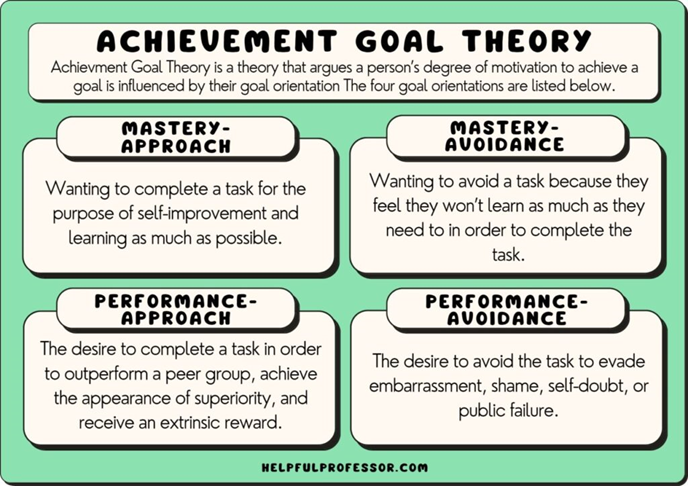
If you haven’t heard of these terms yet, you will soon come across them in the 2×2 matrix of Andrew J. Elliot; it involves a theory that outlines the internal factors of motivation. Let me explain to those who stuck around even after I said ‘theory’.

The Achievement Goal Theory: Approach (that’s another clue) Matters!

We self-evaluate our performance and come to a conclusion, or in other words, define our competence, using three standards, which I’ve reframed as questions:

  • Am I succeeding in doing this task?
  • Am I learning something new or accomplishing something I didn’t before?
  • Am I performing better than or like others?

Competence is also measured in terms of valence—success/positive outcomes and/or failure/negative outcomes. A ‘valence-based’ evaluation of goals brings out our avoidance or approach tendencies. We either find ourselves approaching goals expecting a positive outcome like growth and achievement (mastery), e.g., goals such as attending a seminar, learning a new skill. Or, we might find ourselves avoiding something we think might turn out negatively, like working on a dissertation, applying for a job, or attending an interview. There is a risk margin for such goals. We might feel the urge to avoid the criticism, negative evaluation or judgement that accompanies a possible failure or setback.

Source: Verdin, Dina & Godwin, Allison & Morazes, Jennifer. (2015). Qualitative study of first-generation latinas: Understanding motivation for choosing and persisting in engineering. ASEE Annual Conference and Exposition, Conference Proceedings. 122.

The underlying emotions behind the approach-avoidance perspective is the real predictor of motivation. Think of a goal you are trying to avoid out of a fear of a negative outcome. Now try to reframe that negative outcome to something positive. Let’s do it together:

Step 01: Write down your goals on a paper. Be sure to record all your goals without disregarding any because you think they might be unattainable. We will evaluate their feasibility at a later time.

Step 02: Categorise them into four boxes as given in the image, e.g., Goals that come under Mastery – Approach, Mastery – Avoidance, etc. This will help you uncover the emotional-basis of your goal approach. Refer to this grid to understand the meaning of each box heading so you can place your goal in the appropriate box.

Step 03: Reassess and recategorise your goals. Even if there are overwhelming, seemingly impossible-to-attain goals, reconsider why you may be putting them in the ‘avoid’ category. What is the underlying fear or self-judgement stopping you? You can write them down, discuss them with a coach or mentor or simply self-reflect. This might bring out a different perspective or motivation, or even the courage to approach something difficult.

Now, is there any goal that you would like to relocate from avoidance to approach?

Here’s my example:
Recently, I was trying to use Microsoft Excel to organise my literature review references. An overwhelming fear of not being able to do it right took over and I gave up on my task halfway. The next day, however, when I opened Excel with the determination to learn something new even if I won’t be able to master it, I ended up learning the application and organising my references with ease—ironically, mastering Excel. This is how I moved an overwhelming task from ‘avoidance’ to ‘approach’.

As an emerging graduate, it’s a good idea to spend a window of time planning your goal-setting approach. The Achievement Theory matrix gives clarity on your goal motivations and progress—and can help you tackle the stress and overwhelm of meeting all your goals. We’ll talk more about goal-setting in subsequent blogs; for now, I would like you to reflect on your goals and your approach towards them. We would love to hear about your progress!

As an emerging graduate, it’s a good idea to spend a window of time planning your goal-setting approach. We’ll talk more about goal-setting in subsequent blogs; for now, I would like you to reflect on your goals and your approach towards them. We would love to hear about your progress! If interested, you may read more about the Achievement Goal Theory here.

Categories
Uncategorized

On Scientific Curiosity: Why we need to ask more ‘Whys’

By Madhuri Rajkumar

In the 20th century, in a bustling suburb of metropolitan Chicago, a telephone equipment company – the Western Electric Company – emerged as a monopoly supplier of telecommunication hardware. There was an interesting phenomena being studied at Hawthorne, where their factory was located—the subsequent investigations puzzled the factory owners, academicians, and industry experts.

Now, before I proceed with this story, let me ask you a question.

What, in your opinion, drives your productivity?

Here are some common answers:

  • The anticipation of receiving a reward, like a bonus or incentive
  • A determination to succeed at something challenging, new or interesting
  • A sense of commitment to what you have chosen to do
  • The pleasant feeling that arises when being noticed or validated for your work

At Hawthorne, a study was conducted to understand the effects of changing work conditions, like lightning, break times, etc., on the productivity/performance of employees. Somehow, the employees consistently produced high output even when the experimental conditions included longer working hours and shorter breaks. Who would ever feel motivated to perform under these conditions? Would you?

This led to the first and most important question a researcher/scientist/psychologist should ask: ‘Why?’

Children ask ‘Why?’ expecting an epic story to something as mundane as the working of cars or the flowering of a tree. ‘But why?’ they ask, a million times, to the frustration of parents who become the best storytellers in that moment of interrogation. But this small yet powerful word becomes the gateway to valuable information about others/the world and oneself. 

Somewhere along the way, however, we outgrew this stage and started accepting close-ended answers to our questions, in the form of rules and facts, often categorised as wrong or right. Conforming to the rules and keeping within bounds meant security and sustenance.

As a psychologist, however, we decide to be anti-conformists. The grey area of not knowing keeps us motivated to test new hypotheses and develop new theories. We regress into the child-like habit of asking ‘Why?’ And the subsequent investigation on why people do things or behave the way they do leads to new insights that make life easier – like what happened in the Hawthorne Studies.

So, what was happening at Hawthorne?

The factory owners at Hawthorne became interested in this productivity phenomena and they wanted to use whatever was happening there to improve productivity of all their employees. So, they called in the big guns — academicians like Elton Mayo, who insisted on understanding the behavioural and psychological reasons behind productivity. His deep dive into this aspect of motivation developed some turning-point answers in management studies. It became evident that people want to be noticed, attended to and cared for. They want to be involved and regarded, rewarded and understood. If this discovery didn’t happen, we would have been ages behind in understanding employee motivation and consequently developing effective management techniques. So, cheers to Elton, the other investigators and the factory owners who didn’t stop asking ‘Why?’

“When curiosity turns to serious matters,
it’s called research.” 
Marie von Ebner-Eschenbach

Every day we make observations. We make observations about the people around us, our surroundings, and if self-reflective enough, about ourselves. Out of these, even if we choose to ignore some, something else might keep us awake, wondering ‘Why?’ And there begins your scientific journey to establish lines of evidence to either credit or discredit these observations. Once you’ve arrived at satisfactory conclusions, you apply them to real life and test the outcomes. It doesn’t stop there. You test and re-test, keeping in mind that there is no right or wrong, only a series of developments to how things were vs how things can be.

So, fellow psychologists, here are some takeaway messages, not only from enterprising studies like the Hawthorne Experiments, but as observed from instances of daily life:

  • Be constantly and forever intellectually curious
  • Do not limit yourself to a single answer; yearn to know more
  • Finding evidence to prove yourself wrong is also as valuable as evidence to prove yourself right (A good observation/study is always falsifiable)
  • Use your curiosity for the good of others, with a determination to make their lives better or easier

Elton Mayo and his fellow researchers played a role in inspiring a culture of active listening, empathy and interpersonal support in the Western Electric Company, positively influencing many workers’ lives – all because they couldn’t stop thinking about why people kept working under poor lighting.

Here’s a link to read more about the Hawthorne Experiments, the ‘Hawthorne Effect’, and its various implications: https://www.bl.uk/people/elton-mayo. We’ll also talk about Evidence-based Practice (in later blogs), which is the standard in Occupational Psychology (briefly mentioned through the diagram above). And once inspired,

Take a look at the world around you, your work or academic space and think of where you may have missed out on asking the big question: ‘Why?’

Categories
Uncategorized

The Power of Networking

By Himanshi Naredi

As an Industrial-Organizational Psychology graduate, I’ve come to appreciate that success in this field isn’t solely about book smarts. Networking, an often-underestimated tool, holds the key to landing your dream job and expanding your professional horizons.

One of my most impactful career moves came through networking. I offered my services informally and for free to a team for few weeks. A year later, they reached out with a full-time paid offer. This experience underscores the potency of informal networking.

Networking isn’t just about exchanging business cards; it’s about creating genuine connections. Engaging with professionals opens up fresh perspectives and offers invaluable insights. I’ve found that listening to others’ journeys and identifying shared experiences has propelled me forward in my own career.

Beyond personal experiences, networking offers I/O psychology graduates a wealth of opportunities. It helps you stay abreast of industry trends and innovations. Through networking, you’ll meet individuals who are steps ahead in their journey, offering mentorship and guidance.

However, it’s worth noting that I/O psychology programs often fall short in emphasizing the power of networking. Unlike business management degrees, opportunities for formal networking are limited within the academic realm. This leaves I/O graduates in the challenging position of navigating the networking landscape on their own.

Networking is not confined to specific events or formal settings. It can happen anywhere, from conferences to online platforms (like LinkedIn) and even informal gatherings. By actively seeking out and nurturing professional relationships, you’ll open doors to unforeseen opportunities.

To the I/O psychology graduates, I encourage you to recognize the potential of networking. Attend events, engage with professionals, and watch how it transforms your journey from promising to extraordinary. The connections you make today could very well be the stepping stones to your dream job tomorrow. Remember, networking isn’t just about advancing your career; it’s about forging meaningful connections that can shape your professional journey for years to come.

Pro-Tip: PsyPub is a great place to start!

About the Author

Himanshi Naredi is a graduate based in London, interested in Leadership, Psychometric Assessments, Workplace Wellbeing and using psychology to boost organizational performance. With a BSc in Psychology from King’s College London, she pursued an MSc in Occupational Psychology from Goldsmiths, University of London. Her work experience highlights her dedication to making workplaces better and helping organizations make smarter decisions.

Categories
Uncategorized

Timon De Graaff on Equity, Diversity & Inclusion

HRBP Go To Market & Leadership Development Specialist bij Unilever

By Amanda Lopes Pacca

Timon is so kind that just looking at him makes you smile. It is not out of purpose that he is working with diversity & inclusion. Humble enough to admit the challenges of human nature and the possibility of a biased position, he drives you into a conversation that makes you feel that you want to stay and learn more.

We talked through different topics, including employer branding, innovation, creativity, and Diversity & Inclusion.

When talking about employer branding, Timon expressed that it is all about how you stay true to yourself, what is your value and what do you stand for. Social commitment, for example, is an important topic, giving equal opportunities to everyone in a fair way. He talked about the expectations of the stakeholders and the alignment of your ideas with the people around you. The change will happen by getting everyone on the same page. Timon said that we are not there yet, and people may feel scared or uncomfortable with the unknown, but consciousness is the first step.

In his opinion, the important thing to think concerning employer branding is: What is the higher goal of doing it? And to give people the opportunity to share their ideas, also aligning those ideas with the stakeholders. It is needed to start slowly and then go further. 

Talking about psychological safety, Timon stated that it is possible to drive diversity but the company has to have an inclusive culture for both sides to stay together. With inclusion, people will feel safe to speak up, bringing more innovation, business growth and performance. Diversity always exists in the environment, however, will just take the place it deserves if the company opens space for inclusion.

Timon also spoke about policies to drive diversity & inclusion stating that it is necessary to foster equity, giving everyone the same opportunity. Timon reflected by saying that people are not the same, in this sense, “we all start from different points in life”, we have different experiences. This fact needs to be considered from an inside perspective of the company, looking at the process and questioning the equal opportunities depending on the background and history of people that work there. Timon emphasizes how this is an important topic to start right and then work on top of it.

He also touched on important topics surrounding human nature and psychology, how we are individuals that feel belonging to people that are similar to us, and how we have to be careful about our biased actions in what we are doing since this is the path to be an inclusive company. According to him, that is why it is so hard to drive diversity. For this concern, an important question to ask is: How can we address bias? He also talked about us finding our truth and values, being able to have a voice knowing what matters to us.

When we talked about making mistakes, Timon brought an essential reflection about the peoples’ intentions and the importance of questioning those. Where are these intentions coming from?

When I asked him about guidance for recent graduates that want to join this path of diversity & inclusion, he talked about learning how to be resilient, knowing your personal values and what matters to you, also being open to realising your bias and exploring your feelings of discomfort.

We perceive that it is not easy to be resilient, to get to know your inner voice, and sometimes to have the courage to share your ideas. The important thing is to start to practice, and this will just happen through action. We cannot change the way we put ourselves into the world if we do not change the way we act towards it. Therefore, listen, observe and act- consciously and actively to build the life and future you wish for yourself.

Timon is so thoughtful and manages to touch us uniquely, bringing a comfortable environment for us to express our opinion. I hope that if you want and when you see the interview you can also be touched and reflect on how you are including and accepting the diversity of the world and your own being.

Interview Link on the PsychologyAtWork.Blog YouTube channel: 

About the Author

Amanda is a final year student of the WOP-P Master in Work, Organizational and Personnel Psychology. Brazilian by birth, her journey into psychology began before she graduated, at the age of 17, when she came into contact with Psychoanalysis. From then on, her passion for understanding the human mind expanded, and she graduated in Psychological Sciences at the University of Coimbra in Portugal. In her last year to become an occupational psychologist, her topics of interest cross all human nature, including leadership, psychological empowerment, emotional health, and mental problems. Her hope of contributing to the blog is that this vast universe of psychology could be accessible to as many people as possible through writing. Psychology has a long past but a short history. In this sense, psychology professionals owe it to the world of psychology and its precious knowledge to expand that so more people can think better about themselves, the world, and their desires.

Categories
Uncategorized

Amanda Potter on Internships, Networking and Founding a Leading Consultancy

Amanda Potter, CEO at Zircon Management Consulting Ltd

By Amanda Lopes Pacca

Getting to know Amanda Potter for the first time was like staying with a familiar. Her kindness, openness, and attitude bring a feeling of “home”. 

Amanda Potter is the CEO at Zircon Management Consulting and has vast experience in diverse areas of occupational psychology. Despite all her professional achievements, she stays human and humble with life, and she showed in the interview I made essential lessons and reflections for the “beginners”. 

The complete interview with Amanda is already on our YouTube channel, and you can find a link at the end of this post. Here I will touch on important topics and reflections that she gives to us. 

To start, we all know that the first steps of our professional careers are not easy. We need to apply for jobs, go through interviews, deal with our CV and cover letters. All challenges are the process of showing our best side to have a place, a space that we can show ourselves and be valuable to the company. 

This process takes a lot of energy- it is what we call the recruitment and selection process in human resources. But something changed through time. Before the company used to choose the individuals, they stayed more passive, waiting for responses and hoping to find a good job. Today, everything is different, or at least expected to be. Of course, for the ones who dive into this change. The company chooses the individuals, but they also choose the company. They are no longer passive individuals, but pro-active ones who can build their futures ahead of them and think, rethink and think again in what they really want for their lives- in this first path. 

The individuals have the possibility and facilities due to technologies to search the company, the culture, and they can really decide based on their preferences what they really desire. 

A difficult question that I want to ask you: What do you really desire?

As Amanda said, the important thing is not to find the correct answers but come up with questions. 

However, do you think all recent graduates, students, or professionals that really want a role go deeply through it? I am not so sure about it. Our generation is mostly short-sighted, anxious, and seeks success and quick results. We have a hard time dealing with failures and waiting.

Amanda Potter showed how it is necessary to have time and be dedicated to doing simple things, such as filling out a form or being proactive enough to know how you can contribute to a company, rather than expecting them to contribute to you. She showed how a relationship is based on a mutual connection, receiving and giving. 

Connection, reconnection, a learning life process. Are you ready for that? To learn, make mistakes, and face your own failures?

It is important to repeat that the essential thing is not just expecting but offering. Thinking about what you have to offer and the best way of doing it. 

Amanda also indicated how companies look for courageous and proactive people who show that they can contribute to them. She highlighted all these essential aspects and attitudes expected by an intern. It was possible to see through the knowledge she shared that in the end, what the company wants is not an expert- is a human being open to challenges, available to know how to work in teams, someone who knows how to communicate effectively, receptive to commit mistakes but more open-minded to learning how to deal with them in a responsible manner. An individual who is open to taking time, researching the company, understanding their desire, and filling a form until the end. 

Filling a form here could have a symbolic meaning. It involves being compromised with what you really want, being compromised with yourself.

This is a personal challenge in times like ours. We need to develop patience, waiting, and active listening. However, we can’t fool ourselves. We have to step up and see the world with prudent eyes: it takes time to build a career, it takes time to grow, it takes time to learn, it takes time to search for the right job, it takes time to think about your desire and really choose your life. 

It takes time. It involves frustration, committing mistakes, and facing your fears. And it is impossible to conquer the life you want without living it and going through the process. 

In the end, Amanda also said to interns to pick themselves up, learn from their mistakes and keep trying! Moreover, she reported on the importance of taking time to get to know people and build mutual relationships! Finally, she advised that if you send a LinkedIn invitation, include a message on why you want to connect to this person! In a sincere, open, and captivating way, Amanda reflected the reality of life. 

And now I am saying to you, dear reader, really keeps trying, without deceiving yourself. Try with your heart, and wait for life to show you the results of your actions.

Amanda finished sharing her lessons, throwing back to the moment when she was an intern: “Don’t feel like you need to come with the answers. As long as you are prepared to learn, to ask questions, and be open to feedback, then you will be fine”. 

Interview link on YouTube:

https://www.youtube.com/watch?v=WEoWHeld8ug

About the Author

Amanda is a final year student of the WOP-P Master in Work, Organizational and Personnel Psychology. Brazilian by birth, her journey into psychology began before she graduated, at the age of 17, when she came into contact with Psychoanalysis. From then on, her passion for understanding the human mind expanded, and she graduated in Psychological Sciences at the University of Coimbra in Portugal. In her last year to become an occupational psychologist, her topics of interest cross all human nature, including leadership, psychological empowerment, emotional health, and mental problems. Her hope of contributing to the blog is that this vast universe of psychology could be accessible to as many people as possible through writing. Psychology has a long past but a short history. In this sense, psychology professionals owe it to the world of psychology and its precious knowledge to expand that so more people can think better about themselves, the world, and their desires.

Categories
Uncategorized

Rob Robson on Organisational Change and Employee Engagement

By Amanda Lopes Pacca

Reflections, insights, questions, and mainly the reality of the practical world in the approach of complex issues is what emerged from the interview with Rob Robson about change, employee engagement, and feedback, ending with a question about leadership: after all, what makes a good leader in the 21st century?

Rob Robson’s work areas include employee feedback and engagement, with deep experience in change and significant business experience. He has the most experience in leadership, engagement, and motivation.

Shall we reflect together, or rather, with Rob, on essential aspects of the career of an occupational psychologist? Read the blog all the way through to see the interview’s highlights, which are also available on our YouTube channel.

To start with the theme of organizational change, so recurrent in a complex and ambiguous world in constant alteration, we can ask: Would changing situations in the organization be an illusion? Should we talk about what to do in non-change cases instead? How to materialize, sustain and carry out effective changes?

We know that there are no magic solutions, rules, or tips for complex questions, not least because it all depends on the context and which individuals one should consider. Rob clarified that focusing on change alone can be misguided, as the focus should be on what you really want, on what is the target, behaviour, process, and not necessarily described in terms of change. In his opinion, people know that things change all the time, but why should you do it, how involved you are in the process, and the importance of letting people figure out and understand the importance of the change in their lives.

Rob was involved with extensive transformation processes in companies during his career. In his experience, he saw people with deep concerns about it, as they are involved in situations, which makes them see issues and things – and understand that working with people in Rob’s view really helps. The focus has to be where you want to go and how people get there, rather than focusing on the mechanics—building the interaction with people! “Get practical, with the models in the back of your mind”- as he said.

About the theme of engagement mixing with change, Rob pointed to the challenge object of engagement. He said that it requires interpretation, the data you have, and what you will do in practical terms. Interpretation in this sense is to ask the implications of the theories, surveys, questionnaires, and what it is tried to achieve in the real world and for people’s strategies. He said that it is an advantage if you have an engaged force to achieve change. However, on the flip side, changing badly is relatively easy to disengage and disempower people. Engagement is a process, in his view, getting people interested, removing fear, creating conditions, and going beyond traditional engagement!

Getting to people, allowing them to express themselves, and contributing to the design, all aspects of self-determination theory are crucial in Rob’s view. He also showed with these reflections that getting in touch with people as human beings, listening to them in the most profound ways. Still, dealing with people also has challenges and big ones. 

Talking about employee feedback, Rob showed others and exciting perspectives. He pointed out that no matter what kind of feedback, no one finds that an easy task, there is the giving part and the accepting partboth being challenged. He talked about reversal theory (dealing with what is motivating us right now) and the importance of feedback: doing with fear of the person not liking you or what you have to say, and whether or not this helps the other person. Self-questioning is essential. For him, if it’s not going to help, why say it? If it’s to make the person feel free to ‘get rid of it,’ that’s not really what giving feedback is about. 

Feedback in his view is not about “getting rid of it” in an individual logic of who gives the feedback, but about how much it helps who is receiving it. 

He also emphasized the difference between master and sympathy. Master is the want for improvement, and sympathy is the want to feel cared for and friendly. In his words, knowing that you will receive feedback could make you think: “what can I learn from this?” Considering more the master perspective, that no feedback could do any harm– or is to improve, or if you don’t think that way, it is also necessary to filter it. 

But Rob also showed that sometimes it is easy to say and difficult to do

We know that, right? When we talk about emotions, we know that we can control them (sometimes yes/no), but we cannot make them not occur. They come and happen, even though we don’t want to feel it. 

To write one more reflection that Rob introduced about feedback is the overplayed importance of it. And I ask you: Do you think that also happens? Or do human beings give the proper attention to the topic? 

With a tip for that, Rob showed that sometimes information is more valuable than feedback, and it is possible to get them everywhere. In the “unspoken,” many things are said and likely to be understood. Rob pointed out that sometimes feedback can only be a saying that is already in progress in the information available even before it is reported. 

To not give you more spoilers, as I can imagine, you will want to see the whole interview. Rob finalized with essential reflections about the leader’s role. In his own words “Being a leader is working in a discomfort area and accepting it”. 

But I will end on this point, with a not saying of the rest. So I leave you with the curiosity, reader, to see in full this interview with many crucial issues, sayings, and non-sayings of professional practice. 

Interview link on YouTube: https://www.youtube.com/watch?v=Yz7ZYiBXsy8&t=70s

About the Author

Amanda is a final year student of the WOP-P Master in Work, Organizational and Personnel Psychology. Brazilian by birth, her journey into psychology began before she graduated, at the age of 17, when she came into contact with Psychoanalysis. From then on, her passion for understanding the human mind expanded, and she graduated in Psychological Sciences at the University of Coimbra in Portugal. In her last year to become an occupational psychologist, her topics of interest cross all human nature, including leadership, psychological empowerment, emotional health, and mental problems. Her hope of contributing to the blog is that this vast universe of psychology could be accessible to as many people as possible through writing. Psychology has a long past but a short history. In this sense, psychology professionals owe it to the world of psychology and its precious knowledge to expand that so more people can think better about themselves, the world, and their desires.